If you’ve been planning a trip to Jim Corbett and someone pointed you toward the Dhikala Zone, that’s solid advice. This isn’t just one more safari zone tacked onto the park — it’s the one that serious wildlife photographers and nature travelers consistently rank at the very top of their list, and for reasons that become obvious pretty quickly once you’re there.
Let’s get into what actually sets Dhikala apart from everywhere else in Corbett.
What Is Dhikala Zone?
Dhikala is the largest and best-known safari zone inside Jim Corbett National Park, sitting deep within the reserve’s core area — meaning wildlife here moves with minimal human interference, largely on its own terms.
The zone spans dense Sal forest, broad open grasslands known locally as chaurs, and the banks of the Ramganga River. That blend of habitats is exactly what makes Dhikala so wildlife-rich and, honestly, so photogenic.
Getting in means passing through Dhangarhi Gate, roughly 18 km from Ramnagar, and then another 30 km deeper into the forest before you reach the Dhikala complex itself.
Why Dhikala Pulls Ahead of the Other Zones
Corbett has several safari zones — Bijrani, Jhirna, Dhela, Durga Devi, Garjia, among others — and each has its own personality. But Dhikala plays in a different category altogether.
Scale is the first thing. Nothing else in Corbett comes close to its size, which means longer, more varied safari routes and more opportunities to run into different animals across different terrain in a single drive.
The landscape does a lot of the heavy lifting too. The Dhikala chaur is one of the largest grasslands anywhere in the region. Stand at the watchtower near the rest house and look out across that grassland toward the Ramganga riverbed, Himalayan foothills rising behind it — it’s the kind of view that looks almost staged, except it’s completely real. You won’t find a comparable vista in any other zone here.
Wildlife You Can See in Dhikala Zone
This is really where Dhikala’s reputation gets earned.
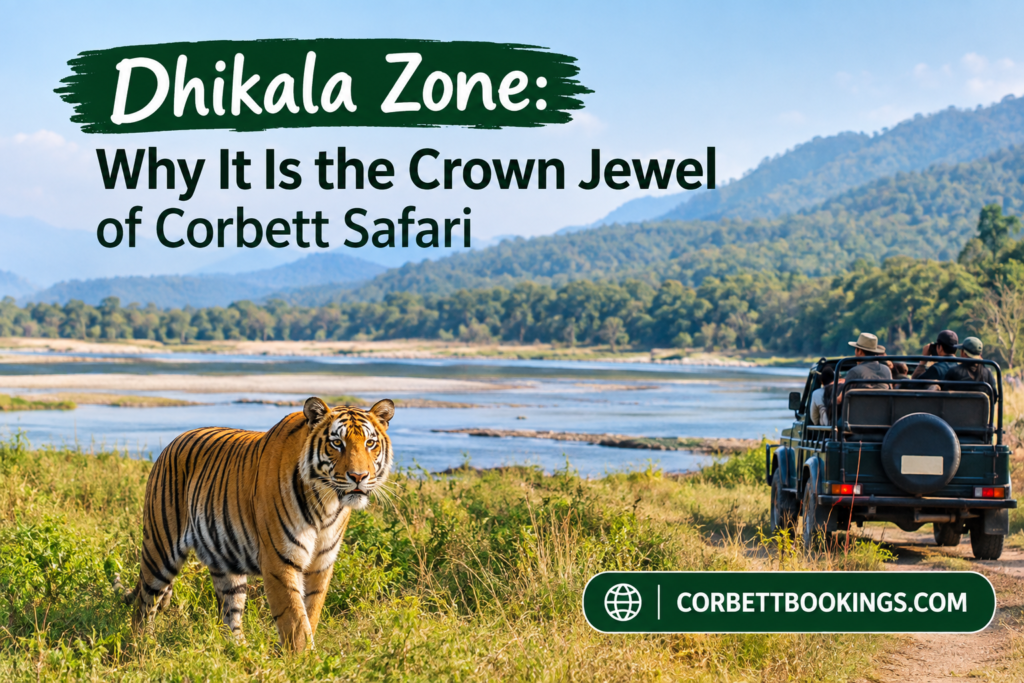
Bengal tigers are the obvious headline act, and Dhikala delivers some of the best open-landscape tiger sightings anywhere in India. Because the chaurs are wide open, a tiger crossing that ground is visible from a genuine distance — no thick brush getting in the way, just clear sightlines and a tiger going about its business.
Asiatic elephants show up here in real numbers too, especially near the Ramganga flood plains during summer. Watching thirty or forty elephants move as a herd across open grassland is not something you forget easily.
Beyond the headline species, you’ll regularly spot spotted deer, sambar, hog deer, barking deer, wild boar, jackals, and langurs. Hog deer in particular are seen here more reliably than almost anywhere else in the reserve.
Along the Ramganga’s banks, marsh crocodiles and gharials are common, and the crocodile point near Gairal Rest House is a favorite for close-range viewing.
Birders, take note — over 500 species have been recorded in and around this zone. Crested serpent eagles, ospreys, great hornbills, kingfishers, wood owls, and a long list of waterfowl frequent the Ramganga reservoir area.
The Chaur and the Watchtower
Two spots tend to define most people’s memory of a Dhikala visit.
The Dhikala Chaur itself — that huge grassland the zone is named for — sees elephant herds, spotted deer, wild pigs, and occasionally tigers passing through at dawn and dusk. It’s the kind of place where sitting still and watching pays off, because there’s almost always something happening.
The watchtower is a short walk from the Dhikala Forest Rest House, and from up top you get a sweeping view of both the chaur and the riverbed below. There’s also a man-made waterhole near the tower that draws deer, elephants, and wild pigs throughout the day.
Safari Options in Dhikala Zone
Dhikala operates a bit differently from Corbett’s other zones, and it’s worth understanding before you plan around it.
If you’re staying outside the park — say, at a resort near Ramnagar — the only way in is by dhikala canter safari. A canter is a shared, open-air bus that holds up to 20 passengers, and two runs go out daily: an early morning trip and a midday afternoon one, each lasting around five to six hours.
If you’ve booked an overnight stay at one of the forest rest houses inside the zone itself, gypsy safaris become an option too — a more intimate way to explore, with your own guide and vehicle going deeper into the forest.
Staying at Dhikala Forest Rest House
Spending a night inside Dhikala is a fundamentally different experience from a day visit.
The rest house dates back to the 1890s, and parts of the original structure still carry that old British-era character. It’s the largest forest rest house anywhere in Corbett Tiger Reserve, and its deck looks straight out over the Ramganga reservoir. During summer, as water levels drop, elephants sometimes graze on the exposed flood plains within view of the rooms.
The complex includes a restaurant, a small library, resident nature guides, evening wildlife film screenings, and a few walking tracks — there’s even a post office on site.
One important note: rooms at Dhikala Forest Rest House are limited and get booked out months ahead. If an overnight stay is part of your plan, start that process early.
When to Visit Dhikala Zone
The zone opens November 15 and closes June 15, shutting down entirely through the monsoon.
Within that window, the experience shifts month to month. November through February brings cool, pleasant conditions, comfortable mornings, and excellent birdwatching, with clear forest visibility throughout.
March through May is when sighting frequency climbs. The heat pushes animals toward water sources more often, and thinning vegetation opens up longer sightlines — tiger and elephant sightings peak during this stretch.
Even the final weeks before the June closure can be rewarding, as animals cluster tightly around the Ramganga and its shrinking waterholes.
Dhikala Zone vs Other Corbett Zones
Bijrani offers solid tiger sightings in denser forest and easier access. Jhirna stays open through monsoon. Durga Devi is a strong pick for birders. All of these are legitimate choices depending on what you’re after.
But for open landscapes, the highest concentration of large mammals, herds of elephants, and Corbett’s most dramatic scenery, Dhikala is the one to choose. No other zone gives you quite the same sense of being genuinely deep in the wilderness, far removed from roads and towns.
Frequently Asked Questions
No — gypsy safaris are reserved for guests staying at the forest rest houses inside the zone. Day visitors enter by canter only.
It runs November 15 to June 15, closing completely during monsoon season.
Dhangarhi Gate sits about 18 km from Ramnagar, with the Dhikala complex another 30 km further inside.
March through May sees the highest frequency, though sightings can happen anytime the zone is open.
Up to 20, plus a driver and naturalist guide.
Yes — the campus is enclosed by an electric fence, though guests are advised against wandering outside after dark.
For the rest house, as early as possible — sometimes months ahead. Canter safaris should be booked at least a few weeks out during peak season.
Spotted deer, sambar, elephants, and wild boar appear on nearly every safari. Tiger and leopard sightings are fairly regular, and crocodiles are reliably seen at the crocodile point near the Ramganga.
Conclusion
Dhikala Zone earns its “crown jewel” reputation for a straightforward reason: nothing else in the park delivers quite the same combination. The sweeping grasslands, the wide Ramganga riverbed, the sheer density of wildlife, and that deep, genuine wilderness feeling of being far inside the core area come together into something that’s genuinely rare in Indian wildlife tourism.
Whether you go in as a day visitor on a canter safari or spend the night at the Dhikala Forest Rest House, a Dhikala safari tends to leave an impression that sticks around long after the trip ends.