Most people visit Jim Corbett National Park hoping to catch a glimpse of the Bengal tiger. And that is completely fair. But here is something many travellers do not realise until they actually get there — Corbett is one of the richest birding destinations in all of India. With over 600 recorded bird species, this park quietly holds its own as a world-class spot for bird watching, and once you start looking up, you will never want to stop.
Whether you are a serious birder with binoculars and a checklist, or someone who just enjoys the music of a forest in the morning, bird watching in Jim Corbett National Park will surprise you in the best way possible.
Why Jim Corbett Is Special for Bird Watchers
The park sits in the foothills of the Himalayas in Uttarakhand, and that geography is exactly why it attracts such a variety of birds. You have dense sal forests, wide open grasslands, the Ramganga River flowing through, and the Kosi riverbed just outside the core zone. Each habitat brings its own set of species. Resident birds, migratory visitors, hill birds, water birds — they all coexist here across different seasons.
Birdlife International has recognised Jim Corbett as an Important Bird Area, which is not something every park can claim. That recognition reflects just how significant this place is for avian diversity in South Asia.
Best Zones for Bird Watching in Jim Corbett
Not all zones are equal when it comes to birding. Here is a zone-by-zone breakdown so you can plan your visit properly.
Dhikala Zone — Grasslands, Raptors & Reservoir Birds
Dhikala is, like, the most famous zone in Corbett, and for birders it earns that reputation every single time. The wide open grasslands, locally known as chaurs, attract ground birds, birds of prey, and waterbirds around the Ramganga Reservoir, especially during winter. On one safari, you can expect to see Pallas’s Fish Eagle gliding over the water, Great Thick-knee staying perfectly still in the grass, and flocks of migratory ducks settling on the reservoir. The Dhikala Canter Safari covers a broad stretch of this zone and it gives that wide open viewing that makes birding feel easy, almost breezy. The whole zone usually runs from mid November to mid June.
Bijrani Zone — Forest Meets Grassland in One Safari
Bijrani is the zone that keeps birders coming back. Unlike the wide open plains of Dhikala, this zone gives you a layered experience — dense sal tree patches sit right alongside open riverbeds, which means the birds you encounter shift completely within the same outing. The Crested Serpent Eagle, Changeable Hawk-Eagle, Rufous-bellied Niltava, and the iconic Great Hornbill are all regularly spotted here. The sightings in Bijrani feel more intimate and personal, the kind where you pull over quietly and watch a bird for several minutes without another vehicle crowding in. If you want depth over breadth in your birding experience, Bijrani delivers it well.
Durgadevi Zone — The Himalayan Birder’s Hidden Gem
Durgadevi zone feels like a different park altogether. The terrain is hilly and heavily forested, the tourist footfall is low, and the birds you find here are not the ones you will spot in the other zones. This is where you come looking for Himalayan species. The confluence of the Mandal and Ramganga rivers within this zone has produced sightings of Ibisbill, Wallcreeper in winter, Blue-winged Minla, Long-tailed Broadbill, and Ultramarine Flycatcher. Because fewer vehicles pass through, the forest stays calmer and the birds stay closer. For serious birders, a morning in Durgadevi can easily be the highlight of the entire trip.
Dhela Zone — Year-Round Birding with Water as the Draw
What sets Dhela apart from most other zones is that it stays open throughout the year. That alone makes it valuable for travellers visiting during shoulder months when Dhikala and Bijrani have closed for the season. The zone has a water reservoir within its boundaries, which consistently attracts both resident waterbirds and migratory visitors depending on the time of year. The habitat mix of dense forest and open water gives you a decent range of species without requiring multiple zone permits. If you are planning an off-season visit and still want a productive birding outing, Dhela is your most reliable option.
Sitabani Buffer Zone — No Rush, Just Birds
Sitabani Zone is a place that experienced birdwatchers often prefer to keep as their little secret. It sits right outside the core tiger reserve so you do not really need a safari permit to step in. You can walk in, find a calm spot along a forest trail. Then you just observe, at your own pace, no hurry. This area holds more than 500 recorded bird species and since there is no jeep traffic pressure and no fixed time slots , you can stay as long as you want—watch one bird , wait for a particular species to finally show up. The forest feels undisturbed and peaceful, and the birding matches that mood. If anyone thinks jeep safaris are too rushed for real bird watching, Sitabani ends up as a perfect add-on for your Corbett trip.
Also Read: Which is the Most Popular Safari Zone in Corbett National Park?
Bird Species You Can Spot in Jim Corbett
Jim Corbett is not just a tiger reserve. For anyone who pays even a little attention during a safari, it quickly becomes clear that the skies, rivers, and tree canopies here are just as alive as the forest floor. With over 600 recorded bird species, Corbett is one of the finest birding destinations in all of Asia and you do not need to be a serious birder to enjoy it. You just need to look up once in a while.
Here are some of the highlights worth knowing before your visit.
The Great Hornbill
If there is one bird in Corbett that stops people mid-sentence, it is the Great Hornbill. Its sheer size is the first thing that gets you — this is not a bird you easily overlook. The bright yellow casque sitting on top of its massive bill, the bold black and white wings, and that loud, unmistakable call make it one of the most dramatic sightings the forest can offer. Bijrani and Dhikala zones are your best bet for spotting one, and while sightings are fairly regular, the timing can feel a little unpredictable. When it does appear though, it tends to make the whole jeep go quiet.
The Brown Fish Owl
This one rewards the patient visitor. The Brown Fish Owl is a nocturnal predator that spends its days sitting almost motionless along riverbanks, blending into the bark and shadow so well that most people drive right past without noticing. An evening safari near the Ramganga River gives you the best chance of catching it before it becomes fully active after dark. If you do spot one, consider it a genuine treat — it is the kind of quiet, understated sighting that stays with you longer than the flashier ones.
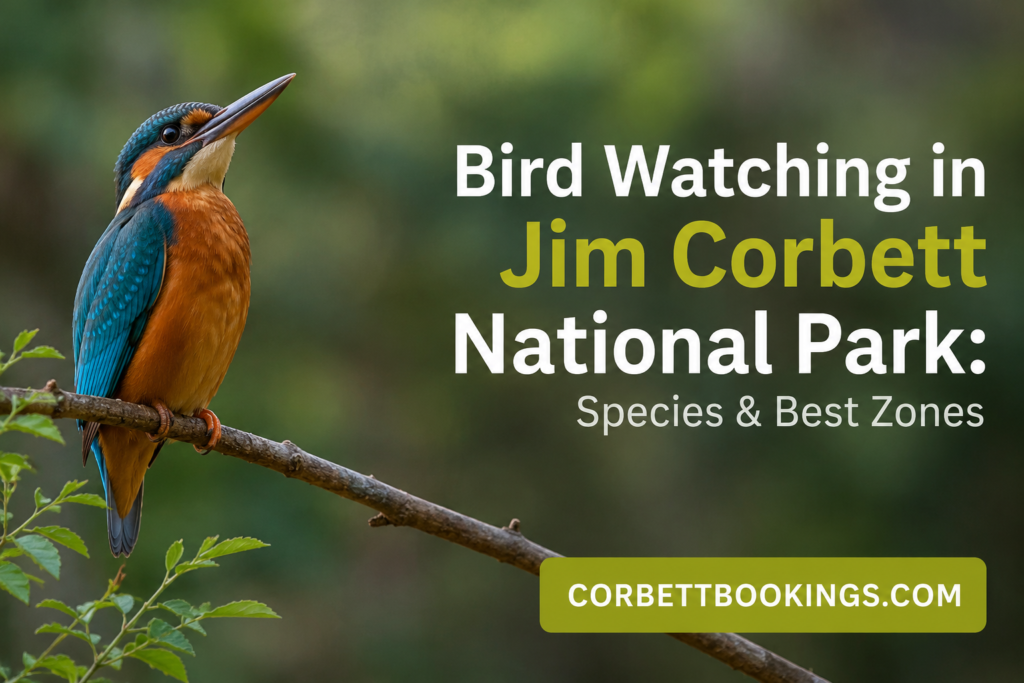
The Crested Kingfisher
Most people are familiar with the small, jewel-coloured Common Kingfisher, but the Crested Kingfisher is something else entirely. Noticeably larger, with a shaggy crest and a preference for cold, fast-moving rocky rivers, this bird is a regular along the Kosi riverbed inside the park. It tends to sit on a mid-river boulder, scanning the water below with complete focus. If you are near the Kosi on a clear morning, keep your eyes on the exposed rocks.
The Everyday Beauties
Not every great sighting requires effort or luck. Common Kingfishers, Green Bee-Eaters, and Oriental Magpie Robins show up regularly even on a casual drive through the park. They are colourful, quick, and surprisingly photogenic — the kind of birds that fill your camera roll before you even realize it. First-time wildlife visitors often find these smaller species are what truly make the forest feel full and alive.
Raptors of Corbett
Corbett is exceptional for birds of prey, and if you keep your eyes on the sky between other sightings, you will rarely be disappointed. The Crested Serpent Eagle is a common but always impressive presence in the canopy. The Black Eagle and Changeable Hawk-Eagle are seen with good regularity too. But the one that tends to draw a collective breath from the jeep is the Pallas’s Fish Eagle — watching one glide effortlessly over the Dhikala reservoir, massive wingspan fully spread, is the kind of moment that makes the whole trip feel worth it.
Migratory Birds — November to March
Between November and March, Jim Corbett undergoes a quiet but noticeable transformation. Thousands of migratory birds arrive from Central Asia and the Himalayas, using the park’s lakes, rivers, and wetlands as a vital resting and feeding ground during their long annual journeys. Greylag Geese, Bar-headed Geese, various species of ducks, Black and White Storks, Great Crested Grebes, and several sandpiper species can all be spotted during this period. For birders, this season adds a completely different dimension to a Corbett visit — the water bodies in particular feel busier and more rewarding than at any other time of year.
Rare and Endangered Species
Corbett has also recorded some genuinely rare birds that even experienced wildlife enthusiasts do not see every day. The White-rumped Vulture, Red-headed Vulture, and the Black-bellied Tern have all been documented inside the park — each of them under serious conservation pressure across India. Spotting any one of these is considered a significant sighting in the birding community, not just a lucky moment. Their presence here is also a reminder of how important protected habitats like Corbett are for species that are running out of safe spaces elsewhere.
Best Time for Bird Watching in Jim Corbett
- November to March is peak season for bird watching in Jim Corbett. This is when migratory birds are present, the weather is cool and comfortable, and the forest is dry enough to see clearly through the trees.
- February and early March is a favourite window for bird photographers specifically because resident birds begin their courtship during this period, which leads to beautiful displays and striking postures — great for photos and observation alike.
- April brings a different kind of birding experience. The forest thins out, water sources become more concentrated, and birds gather around them in large numbers. You can spot 40 or more species in just two safaris if you plan your zones well.
- Monsoon season (July to September) sees most zones close down, but Sitabani and Jhirna remain partially accessible. The forest is lush, nesting activity is intense, and there are almost no tourists, which makes the experience surprisingly rewarding if you do not mind the rain.
How to Book a Bird Watching Safari in Jim Corbett
Safari seats for Jim Corbett are limited for each shift and can sell out quickly, especially on weekends and during the peak season. So advance booking is strongly advised, like as early as you can. You can arrange either a Gypsy Safari (6 seater) or a Dhikala Canter Safari (20 seater) depending on how big your group is and also the zone preference you have.
Gypsy Safari covers zones like Bijrani, Dhela, Jhirna, Durgadevi, Sitabani, Garjia, and Phanto. Morning safaris run from 6:30 AM to 10:30 AM and evening safaris run from 2:00 PM to 6:00 PM.
For hassle-free booking with support from a local team, you can visit corbett safari booking. They handle safari, hotel bookings, and customized tour packages all in one place.
FAQs
Over 600 bird species have been recorded, including both resident and migratory birds.
Dhikala, Bijrani, and Durgadevi are the top zones. Sitabani and the Kosi riverbed are great free-access options.
November to March is the best window, with February and early March being especially good for bird photography.
Graylag Geese, Bar-headed Geese, various duck species, White Storks, Black Storks, sandpipers, and the Great Crested Grebe are common winter visitors.
Early morning safaris (starting around 6:00 to 6:30 AM) give the best results as birds are most active at that time.
Yes. White-rumped Vulture, Red-headed Vulture, Ibisbill, Wallcreeper, and Black-bellied Tern are some of the rare species recorded in and around the park.
Conclusion
Bird watching in Jim Corbett National Park is one of those things that kind of stays with you, long after you leave. you do not need to be some sort of expert birder to really enjoy it. All it takes is a morning safari, a pair of binoculars and a bit of patience, honestly. The park does the rest.
With the proper zone, the right season and a safari booking set in place, you can spot dozens of kinds in one trip, from raptors gliding above the Ramganga reservoir to kingfishers plunging into mountain streams. Corbett feels more than a tiger reserve, and that’s the part people end up liking most.