Jim Corbett National Park is one of those places that stays with you long after you leave. The moment you enter the forest, something shifts. The air gets cooler, the sounds change, and suddenly you are part of a world that runs entirely on its own rules. Nestled in the Himalayan foothills of Uttarakhand, Corbett is not just India’s oldest national park, it is also one of the richest wildlife destinations in the entire country.
Whether you are planning a gypsy safari in Jim Corbett or simply want to know what animals you might spot on your trip, this guide covers everything about the flora and fauna of Jim Corbett National Park in a way that is easy to understand.
The Forests First: Flora of Jim Corbett National Park
Most people focus on the animals, and rightly so. But the trees and plants of Jim Corbett are what make all that wildlife possible. The forest is what feeds the deer, shelters the tiger, and holds this entire ecosystem together.
Over 600 species of trees, shrubs, herbs, grasses, bamboo, and climbers have been recorded inside the park. More than 70 percent of the park is forest-covered, and the dominant tree is Sal (Shorea robusta). Walk through any part of Corbett and you will see Sal almost everywhere, its large leathery leaves catching the morning light.
Other common trees include Khair, Sissoo, Peepal, Rohini, Haldu, and Mango. In the higher ridges, Chir Pine (the only conifer in the park) grows on hilltops like Chir Choti. The upper reaches near Kanda also shelter Banj Oak, a Himalayan species you will not usually find in the lower plains.
What makes Corbett’s forest especially beautiful is the flowering trees, like there is this sudden burst. Semal blooms in big red clusters, Kachnar opens up in pink and white and Dhak (also called Flame of the Forest ) turns the whole jungle orange in spring. Then Amaltas just hangs in bright yellow chandeliers like clusters , it looks unreal. If you happen to visit between February and April, the park looks like something painted, honestly.
The grasslands, called Chaurs, are just as important. These open meadows are where most wildlife sightings happen, especially in Dhikala zone. Over 70 species of grass grow across these Chaurs, including Tiger Grass and Khus Khus. These are the open spaces where elephants graze and tigers walk in the open.
The Animals: Wildlife in Jim Corbett National Park
This is what everyone comes for. The animal list of Jim Corbett is long, diverse, and genuinely exciting.
Royal Bengal Tiger
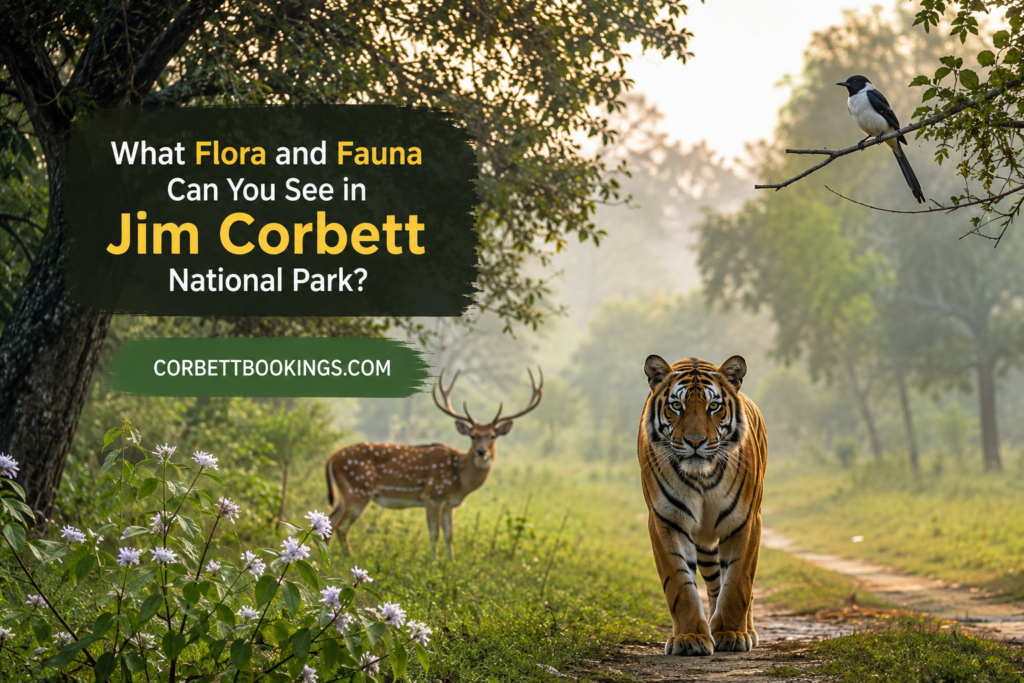
The tiger is kinda the main reason most people end up booking a safari in Corbett. As per the 2022 tiger census, 260 tigers were recorded in Corbett ,which is the highest count among all tiger reserves in India. Spotting one during your gypsy safari in Jim Corbett isn’t assured, but honestly the odds here are better than almost anywhere else.
Asiatic Elephant
Corbett has one of the largest Asiatic elephant populations in the region, with over 1,260 elephants recorded in the 2020 census. Elephants are frequently spotted in Dhikala zone, near the Ramganga River, and in open Chaur areas. Seeing a herd move quietly through the tall grass is something you will not forget.
Leopard
Leopards are present throughout the park but prefer hilly terrain and are more elusive than tigers. The Durga Devi zone and forested ridges are good areas to watch for them, usually early morning or at dusk.
Deer Species
Corbett has four deer species, and they are among the most often seen mammals. Chital ( Spotted Deer ) is the most common, and also somehow the most graceful, it has white spots on a reddish brown coat. Sambar is the biggest deer in the park. Hog Deer and Barking Deer are smaller, and they hang around in thicker, denser vegetation. On pretty much any gypsy safari, deer sightings are almost guaranteed, like you just. end up seeing them sooner or later.
Other Mammals
Beyond the big names, Corbett also shelters wild boar, Langur monkeys, Rhesus monkeys, Indian grey mongoose, Himalayan black bear, porcupine, jackal, dhole (wild dog), and even the occasional sloth bear. The variety is genuinely impressive.
Birds in Jim Corbett National Park
Birdwatchers put Jim Corbett up there as one of the best sort of destinations in Asia, and yeah, for good reason too. More than 600 bird species have been logged here , so it becomes a real serious spot for anyone who likes ornithology.
The kinds of birds you might spot range from the Great Pied Hornbill, Pallas Fish Eagle, Crested Kingfisher and Indian Roller , to the Asian Paradise Flycatcher, Scarlet Minivet, Tawny Fish Owl, and Peacock. Also, in winter, migratory birds drift into Corbett , which means the mix gets wider and wider, so there’s plenty more to notice out there, not just one or two things.
The Dhikala zone, with its open Chaurs and the Ramganga reservoir nearby, is the best area for bird watching in Corbett. Early morning safaris give you the best light and the highest activity from birds.
Reptiles and Fish
In Corbett, the reptile number sits at more than 25 species, which is kinda wild if you think about it. The Ramganga River hosts Gharials and Mugger Crocodiles , two very different kinds of crocodilians that nonetheless end up using the same waterway. You can also spot Rock Python , King Cobra , Common Krait , and Monitor Lizard while you are there.
The river also supports a good variety of fish, including the famous Mahseer, which attracts anglers from across the country. Trout, Rohu, and Goonch are also found in Corbett’s rivers.
Best Zones to See Wildlife in Corbett
The park is sort of split into many safari zones , each one has its own personality to say the least. Dhikala is the most popular, and it gives the nicest open terrain for seeing wildlife , mostly elephants , deer , and also big predators. Bijrani feels really good for tiger sightings in a more wooded or forested feel. Jhirna stays open all year, so you can still get decent opportunities to spot animals even when it’s off season and things are quieter. Durga Devi is pretty much the go to zone for birds and leopards, while Dhela is newer and not as packed, so it works well for people who like a more calm safari routine.
If you want to book a gypsy safari in Jim Corbett across any of these zones, Corbett Bookings offers gypsy safari booking, canter safari for Dhikala, and full tour packages including hotel stays. Advance booking is strongly recommended since permits are limited.
Best Time to Visit for Wildlife Spotting
October to June is the ideal window for visiting Jim Corbett. The summer months between March and June tend to show more wildlife activity near water sources, which makes sightings easier. Winter months are pleasant for travel and excellent for bird watching. The monsoon season sees most zones close temporarily, so planning around that is important.
FAQs
As per the 2022 census, 260 tigers were recorded, the highest among all tiger reserves in India.
Bijrani and Dhikala zones are considered the best for tiger sightings.
Yes, elephants are commonly spotted in Dhikala zone, especially near the Ramganga reservoir and Chaur areas.
Over 600 bird species have been recorded in the park.
Yes, Jim Corbett is one of the top bird watching destinations in Asia, with species like the Great Pied Hornbill, Crested Kingfisher, and Pallas Fish Eagle.
Sal is the dominant tree, covering the majority of the forest. Khair, Sissoo, and Rohini are also very common.
Reptiles like King Cobra and Python are found in the park but generally stay away from safari routes. Sightings are rare but possible near water bodies.
Conclusion
Jim Corbett National Park is not merely a wildlife stop, it feels like a total natural journey. Right from the Sal forests and the blooming Semal trees, to the Royal Bengal Tigers and 600 plus bird types, each corner seems to say, in its own quiet way, how rich and well-balanced Indian biodiversity can be. Whether you’re a first time visitor, trying to catch sight of a tiger, or a seasoned birder seeking some elusive species, Corbett somehow delivers a meaningful bit for everyone.